As I mentioned in this blog post, 2021 was spent learning the game of chess. It started with a simple google that turned into a year long YouTube binge due to Levy Rosman, or as he’s known on YouTube, GothamChess. Gotham taught me a ton about the game, and this video was where I started. From there I created my own process on how I learned chess. Here’s what I did:
- Learn the Rules of The Game
- Learn What Parts of The Game Mean (Opening/Middlegame/Endgame)
- Learn How to take Advantage of a game (Tactics/Forks/Pins)
- Learn an Opening
- Study Study Study
- Endgame, Endgame, Endgame
My purpose for writing this is to give resources for how to learn each one of these aspects. Each bullet point is important to the game, and I want make this a quick way for people to get into chess, and go find all of the relevant information as fast as possible.
1. Rules of the Game
So when you play chess, obviously you need to know the rules right? Even before that, how the heck do you set up the board!? Have no fear! Jon is here! In chess, your goal is to get the enemy king before they get yours. Each piece moves in a special pattern and there’s occasional tricky rules here and there. This chess.com page does a really good job of explaining how to set up the board and how the pieces move.
https://www.chess.com/learn-how-to-play-chess
2 .Learn What Parts of The Game Mean (Opening/Middlegame/Endgame)
Alright, we know how the pieces move, we know how the board is setup, and we know we want to checkmate the other person on the side of the board. How do we start to do that? Chess is broken down into three main parts: The Opening, The Middlegame, and The Endgame. Lets start with the first move: the opening.
The Opening
The openening, well, as it sounds, consists of the first set of moves within a game of chess. White picks a move first and then black responds with a move of their own and the game of chess begins. How do we know whats advantageous for either side? Chess has been played for hundreds of years, and people much smarter than myself have found ways of making specific moves, gotten an advantage from them, and then recorded the moves they make. This is all part of an opening. Players at the Grand Master level (highest title in chess) know nearly every opening, but when you’re starting out, the path I decided to take was learn one opening as white, and one opening as black. With these two starting points, I sought out to learn as close to every variation in that one opening, and move to the middle game from there. How do you go about learning an opening? Ill get to that later!
Middle Game
Ok so we’re through the opening. Down past the five to ten moves I likely have memorized, now what? Enter the middlegame. The middlegame of chess is for me personally the hardest. In the middlegame, you look for tactical strategies to either checkmate your opponents, trade advantageously, or win material. Issue is, how do you know when to do what? When do I push a pawn? When do I trade off a pice? Each opening carries different middlegames, but its often difficult to figure out what to do. Gotham again comes to the rescue. Below is a video to talk about how what to do with pawns in a chess middlegame. https://www.youtube.com/watch?v=h58-sBkPQt8
Endgame
Once all the heavy hitting pieces clear off the board, we are in the endgame. This is where the money is made. Can someone effectively covert a position to deliver checkmate or promote a pawn to get a queen. There are so many variatons of an engame and so many things to study, that its rather daunting. I bought a book and am currently on chapter 3.
3. Learn How to take Advantage of a Game (Tactics/Forks/Pins)
Chess is a game of advantage. After all, you are trying to defeat the person across the board from you. The way this is accomplished is through tricky moves known as tactics. Tactics often involve looking forward a move or several, with hope that your opponent does not catch your plot. When they miss it, you often times end up in an advantageous position. The two main tactics I learned first were Forks and Pins. Not just the common household items, haha.
Forks
A Fork is a situation in which two pieces are under attack, and the attackee will likely end up losing a piece. Forks are most often accomplished with a knight. In the image to the right, the knight is attacking both the king and queen, and the king needs to move out of check. The end result will be the knight capturing the queen, and white gaining an advantage. Spotting forks is a great way to gain an advantage in chess.

Pins
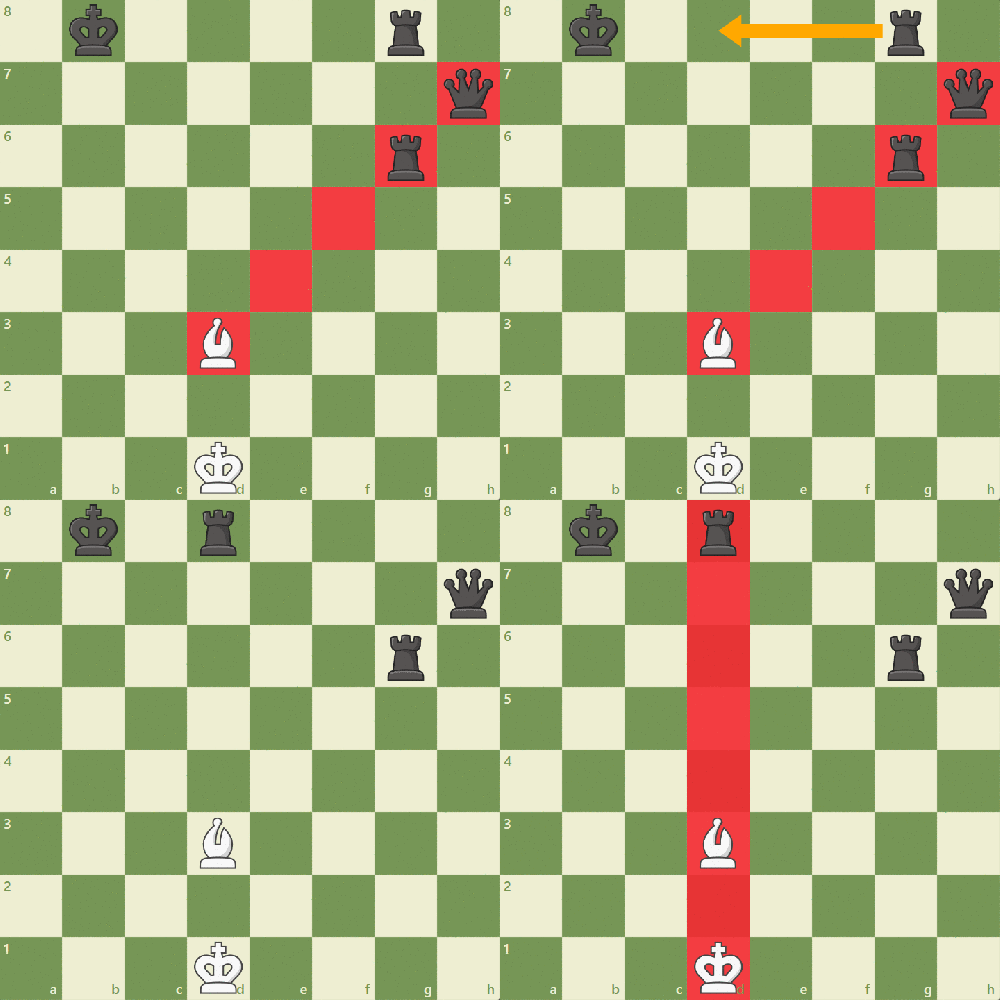
A pin is a situation in which a piece looks through another piece to attack the piece behind it. Pins are accompished with bishops and rooks.
The image to the right shows the two types of pins. First, the bishop attacks the rook and inherently the queen. If the g6 rook moves, the bishop can take the queen! Aha!
Black in turn makes a counter pin, pinning the bishop to the king, so if the bishop moves, the king would be in check. Because of this, white is never allowed to move that bishop while it is “pinned” to the king.
4. Learn an Opening!
As I explained in the beginning sections, the opening is the beginning of a chess match. Its the first 10 or so moves that set the pace for how the game will be played. These are often memorized heavily as each side usually knows what moves gain advantage for them. The best way to go about learning an opening is to learn one as white and one as black. Learn all the variations of that opening and practice, practice, practice.
So with many to choose from, where do I go? Well lucky for us, there are plenty of YouTube videos as well as databases that teach you how to start out with these openings. There are openings that are more typically for the beginner and openings for the more advanced players.
The openings I personally chose to play were:
White: The Vienna
Black: The Caro Kann
Now my opinion should absolutely be taken with a grain of salt. I’m not a chess master, but rather someone for the past year took a lot of joy in learning the game of chess. For me personally, these were the openings I though were good to start with and the ones where I thought the lines were insanely complicated. For my recommendation for where beginners should start and what they should avoid, here are my thoughts.:
Openings To Full Send For Beginners
White
- Vienna System
- London System
- Italian Game
Black
- Caro Kann
- French Defense
Openings to Avoid for Beginners
White
- Ruy Lopez
- Catalan
Black
- Sicilian Defense
5. Play, Study, and Repeat
Now that you know an opening, its time to put that bad boy to the test. The only way you’ll learn chess is by playing games. Youll win some, and you’ll likely lose even more. It will be frustrating at times, but thats ok. That’s the beauty of the learning process. chess.com has this wonderful feature called game review where an algorithm will tell you where you made a big oopsie (blunder) or a small inaccuracy, and then give you an opportunity to see what the best move in the position would have been. This is how you learn the game. Go back, see where you made a mistake, and then never make that mistake again when you get to the same position. Build your chess arsenal and keep going.
6. Endgame, Endgame, Endgame
So the beauty, and well, frustrating part of the endgame, is that all outcomes with seven or less pieces on the board are theoretically solved. Computers are that strong, where they will always know the outcome. The issue, is that under seven pieces, is still MILLIONs of possible combinations. There are engame strategies to get to winning positions in many scenarios, and then situations where you are trying to draw a losing position. The way I’ve gone about trying to learn these endgames is through a book: 100 Endgames You Must Know. The book has been really useful so far, and a few YouTubers recommend it, so why not start here.
Now as I said, I’m only three chapters into this book, so I still have a ways to go. But when I do read, I often feel I calculate engames better. Who knows! Anyways, this is what I used, I’ll let you know my end progress later.

Thanks for following along. Most importantly, have fun playing. Chess is a beautiful game, and I hope you get as much enjoyment playing as I do. Please feel free to send me an email if you have any questions!
-Jon
 A Day In The Life
Leave a comment